Science


Vision
For all our pupils to leave primary school with a deep understanding of both its substantive knowledge and disciplinary knowledge, equipping them with the knowledge and skills required to understand the uses, limitations, and implications of science.
Curriculum Design: How our curriculum is constructed and why?
Here at Roxbourne, children’s science education begins in EYFS through their integrated pedagogy. We provide daily rich and varied opportunities for children to explore the natural world, which build their understanding of important processes and changes. Children learn about the seasons and changing states of matter through carefully planned Outdoor Continuous Provision. This learning is foundational to the subsequent formalised learning in KS1 science.
In KS1 and KS2, our science curriculum teaches pupils a broad and strong knowledge of key scientific concepts alongside disciplinary content (‘how we know this’). By learning substantive (concepts, models, laws, and theories) and disciplinary knowledge (scientific practices) together, pupils develop an understanding of the foundations of scientific knowledge and are able to articulate how this knowledge was gained and may be applied in a range of contexts. This enables pupils to begin to make connections between different aspects of their knowledge, securing a deeper level of understanding and providing a springboard to science learning at secondary level and beyond.
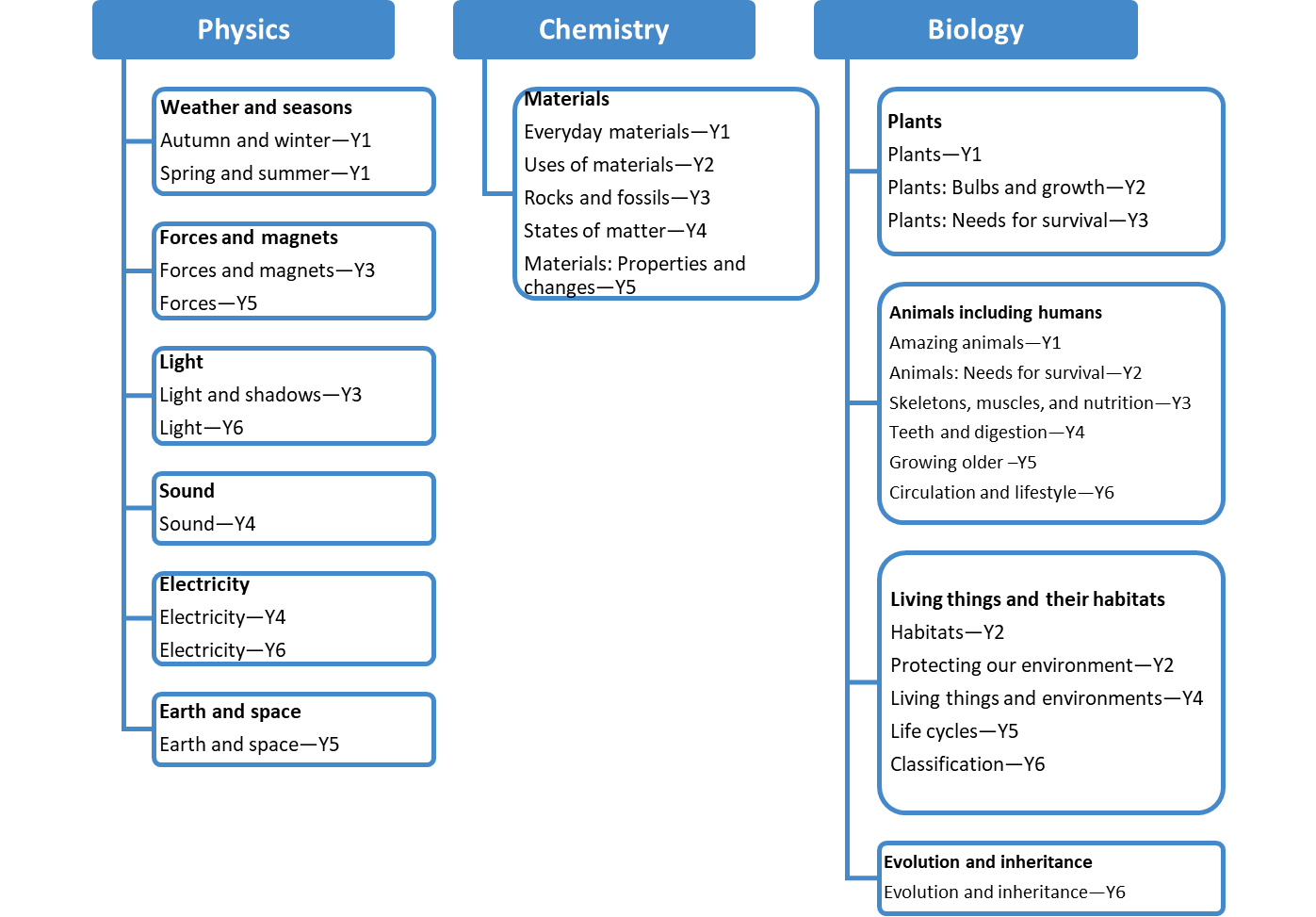
Substantive scientific knowledge is generally divided into three subject strands—Biology, Physics, and Chemistry. However, this distinction is not used in the National Curriculum until Key Stage 3. Therefore, individual topic names (as stated in the National Curriculum) are used in the progression map below.
Curriculum Delivery: What our curriculum looks and feels like in action?
Science is taught twice weekly in KS1 and KS2. We explicitly teach pupils the ‘facts’ of science and make this tangible through frequent experiments that each provides an opportunity to put the scientific method into practice. Through learning about the scientific method, we develop pupils’ understanding of the nature, processes, and methods of science. We expose pupils to different types of scientific enquiry, challenging them to answer increasingly complex scientific questions. Through this focus on scientific enquiry, pupils will begin to appreciate how scientific knowledge is established and, for example, that ‘facts’ are open to revision in the light of new evidence. Science is brought to life further through case studies, highlighting influential scientists’ work and by taking learning outdoors. Our pupils also benefit from carefully chosen enrichment experiences throughout the academic year with clear links to their unit of study.
Alongside our adopted curriculum, our teachers plan drop-down days which are meticulously designed to offer pupils enriching experiences, spanning from charitable fund-raising initiatives to fostering an understanding of the significance of children's mental well-being. Each drop-down day serves a distinct purpose and leaves a meaningful impression on both the children and individuals in our local community who rely on various charities for support in their daily lives. These occasions include Science Week and Outdoor Learning Day. We engage with our wider community by making use of STEM society ambassadors to inspire pupils to consider a job in science, technology, engineering and maths.
Impact: How do we know our pupils are learning, understanding and remembering our intended curriculum?
At the beginning of each lesson, pupils retrieve their knowledge of scientific ‘facts’ by completing a low-stakes quiz. This is used by teachers to formatively assess pupils’ understanding of taught material and address misconceptions. Pupils also complete a series of short questions at the end of each lesson to assess what learning has ‘stuck’ in their minds. Throughout lessons, teachers will use targeted questioning to check and deepen pupils’ understanding; providing support and challenge as required. Pupils’ self-assessment, alongside teachers’ over the shoulder marking, ensures that pupils develop a clear understanding of scientific concepts. Moreover, they are supported to explain their understanding throughout each lesson using relevant scientific vocabulary.
Enrichment in Science
At Roxbourne Primary School, science is brought to life through a carefully planned enrichment programme that runs throughout the academic year. From the Early Years onwards, pupils are given regular opportunities to explore, investigate and experience science beyond the classroom, helping to spark curiosity and deepen understanding.
In the Early Years and Key Stage 1, pupils develop early scientific knowledge through hands-on experiences and local visits. These include opportunities to explore animals, plants, materials and seasonal change, allowing pupils to make meaningful links between classroom learning and the real world.
As pupils progress through Key Stage 2, science enrichment becomes increasingly knowledge-rich and closely aligned with the curriculum. Educational visits and workshops deepen pupils’ understanding of key scientific concepts, support the development of enquiry skills and help pupils see how science applies beyond the classroom.
Pupils take part in high-quality science experiences that challenge and inspire them. These opportunities support learning in more complex areas such as Earth and Space, forces, materials, life cycles, evolution and electricity, while encouraging curiosity, critical thinking and independence.
Key Science Educational Visits and Unit links:
Year 1: London Sealife Aquarium (Amazing Animals)
Year 2: Kew Gardens (Plants)
Year 3: Science Museum (Forces and Magents)
Year 4: Lookout Discovery Centre (Electricity)
Year 5: RAF Colindale (Forces)
Year 6: London Zoo (Classification)
You can find more about our enrichment programme here.